Lose Weight
 Calories in Food
Calories in Seafood
Calories in Mussels
Calories in Food
Calories in Seafood
Calories in Mussels
Calories in Mussels,
Mussel Nutrition Facts
How many calories in Mussels? We provide you with the Mussel calories for the different serving sizes, Mussel nutrition facts and the health benefits of Mussels to help you to lose weight and eat a healthy diet.
Mussels, like Clams, are Molluscs. Inside the shell, the flesh is yellow or orange. Mussels can be steamed, but be sure to throw away the shells that do not open.
Mussels are bursting with vitamin B12, selenium and manganese as you can see below. In addition, Mussels provide a good source of vitamins A, B1-B3, B5, iron, phosphorus, potassium and zinc, as well as other vitamins and minerals. They are low in both fat and calories and provide a great source of protein. They are considered high in cholesterol, although they have less than both Clams and Shrimp.
Mussels contain omega-3 fatty acids. They are thought to help protect us against heart disease and act as an anti-inflammatory. Other Mussel benefits are believed to include reducing the pain experienced from arthritis.
Compare calories in Mussels with the other calories in seafood. A detailed table showing the Mussel nutrition facts can be found at the foot of this page.
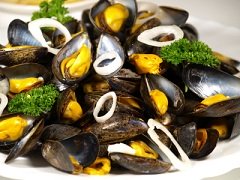
Mollusks, Mussel, Blue, Raw
Refuse: 0%Scientific Name: Mytilus edulis L.
| Serving Size | Calories per Serving |
| 100 grams | 86 kcal (360 kJ) |
| 1 cup, 150 grams | 129 kcal (540 kJ) |
| 1 large, 20 grams | 17 kcal (72 kJ) |
| 1 medium, 16 grams | 14 kcal (58 kJ) |
| 1 small, 10 grams | 9 kcal (36 kJ) |
| 3 oz, 85 grams | 73 kcal (306 kJ) |
Calories in Mussels, Blue, Cooked, Moist Heat
Refuse: 0%| Serving Size | Calories per Serving |
| 100 grams | 172 kcal (720 kJ) |
| 3 oz, 85 grams | 146 kcal (612 kJ) |
Mussel Nutrition Facts
| Nutritional value per 100 g (3.5 oz) | |
|---|---|
| Proximates: | |
| Water | 61.15 g |
| Energy | 720 kJ (172 kcal) |
| Protein | 23.80 g |
| Carbohydrates | 7.39 g |
| Total Fat: | 4.48 g |
| saturated fat | 0.850 g |
| monounsaturated fat | 1.014 g |
| polyunsaturated fat | 1.212 g |
| Cholesterol | 56 mg (19 %) |
| Minerals: | |
| Calcium, Ca | 33 mg (3 %) |
| Iron, Fe | 6.72 mg (37 %) |
| Magnesium, Mg | 37 mg (9 %) |
| Phosphorus, P | 285 mg (29 %) |
| Potassium, K | 269 mg (6 %) |
| Sodium, Na* | 369 mg (16 %) |
| Zinc, Zn | 2.67 mg (18 %) |
| Copper, Cu | 0.149 mg (7 %) |
| Manganese, Mn | 6.8 mg (340 %) |
| Selenium, Se | 89.6 mcg (128 %) |
| Vitamins: | |
| Vitamin C | 13.6 mg (23 %) |
| Thiamine (Vit. B1) | 0.300 mg (20 %) |
| Riboflavin (Vit. B2) | 0.420 mg (25 %) |
| Niacin (Vit. B3) | 3.000 mg (15 %) |
| Pantothenic acid (B5) | 0.950 mg (10 %) |
| Vitamin B6 | 0.100 mg (5 %) |
| Folate (Vit. B9) | 76 mcg (19 %) |
| Vitamin B12 | 24 mcg (400 %) |
| Vitamin A | 304 IU (6 %) |
| Percentages are relative to US Recommended Daily Intake (RDI) for adults. | |
* Samples were obtained from 12 retail stores using a probability-based sampling plan. Some fish had been treated during processing to retain moisture on thawing. Untreated fish = 112 mg sodium/100g.
Source: USDA National Nutrient Database for Standard Reference
You Might Also Like:


Like This Page?
|
Share This Page:
|

Search Our Site:

Free E-Book:

|
Join the newsletter and get a free welcome pack! |
We Recommend:
Looking to get your body into great shape? Get the very best results for your efforts and money! Save your valuable time from surfing the internet. These are theBestselling Weight Loss Programs
Programs that work and have thousands of satisfied customers worldwide!
 |
HOME Privacy Policy Disclaimer Contact Us
Copyright © 2023 Lose-Weight-With-Us.com. All rights reserved.
