Date Nutrition Facts,
Health Benefits of Dates
All about date nutritional information, date benefits, nutrients in dates, calories in dates, nutritional benefits of dates
We are probably more familiar with dried dates, or the sticky version we purchase from the supermarket, but should your local store sell fresh dates then you are in for a real treat. Either way they are deliciously sweet as the fruit is naturally packed with sugar.
Dates are high in calories, approx. 282 calories per serving (100g or 3.5oz), but they contain no cholesterol and almost no fat. They are bursting with fiber, which helps our digestion and may even inhibit bowel cancer.
In the table below we show the nutrition value for one variety of dried date, unfortunately the USDA (US Department of Agriculture) does not have a measure for fresh dates.
Dates provide a good source of iron, copper and magnesium which all work together to build and repair blood cells and prevent anemia. They also provide a good amount of potassium, thought to help give us healthy cardiovascular function.
Research into the glycemic index of dates is not conclusive as they can vary enormously dependant on the variety. Some are considered low, whilst some are high, therefore it’s best to assume they are high, so eat in moderation. They are though, a healthy snack if you have a sweet tooth, replacing unhealthy sugary snacks that you may otherwise eat.
Compare date nutrition facts to the other fruits.
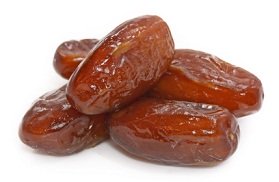
Nutritional Value of Dates
| Nutritional value per 100 g (3.5 oz) Refuse: 10% (Pits) Scientific Name: Phoenix dactylifera |
||
|---|---|---|
| Proximates: | ||
| Nutrients | Dates, deglet noor | Dates, medjool |
| Water | 20.53 g | 21.32 g |
| Energy | 1178 kJ (282 kcal) | 1160 kJ (277 kcal) |
| Protein | 2.45 g | 1.81 g |
| Carbohydrates | 75.03 g | 74.97 g |
| Total Fat: | 0.39 g | 0.15 g |
| Fiber | 8.0 g | 6.7 g |
| Cholesterol | 0 mg | 0 mg |
| Minerals: | ||
| Calcium, Ca | 39 mg (4 %) | 64 mg (6%) |
| Iron, Fe | 1.02 mg (6 %) | 0.90 mg (5%) |
| Magnesium, Mg | 43 mg (11 %) | 54 mg (14%) |
| Phosphorus, P | 62 mg (6 %) | 62 mg (6%) |
| Potassium, K | 656 mg (14 %) | 696 mg (20%) |
| Sodium, Na | 2 mg (0.1 %) | 1 mg (0%) |
| Zinc, Zn | 0.29 mg (2 %) | 0.44 mg (3%) |
| Copper, Cu | 0.206 mg (11 %) | 0.362 mg (18%) |
| Manganese, Mn | 0.262 mg (13 %) | 0.296 mg (15%) |
| Selenium, Se | 3.0 mcg (4 %) | - |
| Vitamins: | ||
| Vitamin C | 0 mg | 0 mg |
| Thiamine (Vit. B1) | 0.052 mg (3.5 %) | 0.050 mg (3%) |
| Riboflavin (Vit. B2) | 0.066 mg (4 %) | 0.060 mg (4%) |
| Niacin (Vit. B3) | 1.274 mg (6 %) | 1.610 mg (8%) |
| Pantothenic acid (B5) | 0.589 mg (6 %) | 0.805 mg (8%) |
| Vitamin B6 | 0.165 mg (8 %) | 0.249 mg (12%) |
| Folate (Vit. B9) | 19 mcg (5 %) | 15 mg (4%) |
| Vitamin A | 10 IU (0.2 %) | 149 mg (3%) |
| Vitamin E | 0.05 mg (0.3 %) | - |
| Vitamin K | 2.7 mcg (3 %) | 2.7 mcg (3%) |
| Percentages are relative to US Recommended Daily Intake (RDI) for adults. | ||
Author: Lana Soko
You Might Also Like:



Like This Page?
|
Share This Page:
|

Search Our Site:

Free E-Book:

|
Join the newsletter and get a free welcome pack! |
We Recommend:
Looking to get your body into great shape? Get the very best results for your efforts and money! Save your valuable time from surfing the internet. These are theBestselling Weight Loss Programs

Programs that work and have thousands of satisfied customers worldwide!
 |
HOME Privacy Policy Disclaimer Contact Us
Copyright © 2023 Lose-Weight-With-Us.com. All rights reserved.
