Lose Weight
 Fruit Nutrition Facts
Lemon Nutrition Facts
Fruit Nutrition Facts
Lemon Nutrition Facts
Lemon Nutrition Facts, Health Benefits of Lemons
The latest research into lemon nutrition facts and the nutritional benefits of lemons has shown that lemons contain unique phytonutrients that act as antioxidants and have cancer prevention properties. Lemons are an excellent source of vitamin C. They support our immune system and protect against rheumatoid arthritis.
Lemons are part of the citrus family of fruits. The East India Company many centuries ago recommended Lemons to combat scurvy for the sailors on long journeys, due to a deficiency of vitamin C. They probably started to appear in cooking from the early 18th Century.
Lemons provide a good source of potassium. This mineral promotes clear thought, regulates the body’s water balance and normalizes our blood pressure. Lemons contain approximately 5% citric acid, which makes them a very good germicide and a natural therapy for fever.
There are just 4 calories in lemon juice per table spoon, which also provides one tenth of the recommended daily intake of vitamin C.
Lemons provide an excellent source of ascorbic acid. A gentle squeeze over bananas, apples and avocados keeps them looking fresh. The peel of the lemon contains pectin and bio flavonoids, an antioxidant, which helps us regulate our body temperature. They are also thought to benefit our cardiovascular systems, help in our defense against colds and flu, boost our immune system and act as an anti-inflammatory.
When buying lemons, try and seek out the non-waxy variety, otherwise wash well to remove all the chemicals before using the peel.
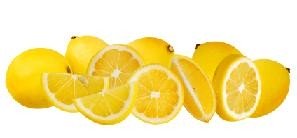
Lemon Nutritional Information
| Lemon nutritional value per 100 g (3.5 oz) | |||
|---|---|---|---|
| Proximates: | |||
| Nutrients | Lemons, raw, without peel | Lemon juice, raw | Lemon peel, raw |
| Water | 88.98 g | 90.73 g | 81.60 g |
| Energy | 121 kJ (29 kcal) | 105 kJ (25 kcal) | 197 kJ (47 kcal) |
| Protein | 1.10 g | 0.38 g | 1.50 g |
| Carbohydrates | 9.32 g | 8.63 g | 16.00 g |
| Total Fat: | 0.30 g | 0 g | 0.30 g |
| Fiber | 2.5 g | 0.4 g | 10.6 g |
| Minerals: | |||
| Calcium, Ca | 26 mg (2.6 %) | 7 mg (1%) | 134 mg (13%) |
| Iron, Fe | 0.60 mg (3 %) | 0.03 mg (0%) | 0.80 mg (4%) |
| Magnesium, Mg | 8 mg (2 %) | 6 mg (2%) | 15 mg (4%) |
| Phosphorus, P | 16 mg (2 %) | 6 mg (1%) | 12 mg (1%) |
| Potassium, K | 138 mg (3 %) | 124 mg (4%) | 160 mg (5%) |
| Sodium, Na | 2 mg (0.1 %) | 1 mg (0%) | 6 mg (0%) |
| Zinc, Zn | 0.06 mg (0.4 %) | 0.05 mg (0%) | 0.25 mg (2%) |
| Copper, Cu | 0.037 mg (2 %) | 0.029 mg (1%) | 0.092 mg (5%) |
| Manganese, Mn | 0.030 mg (1.5 %) | 0.008 mg (0%) | - |
| Selenium, Se | 0.4 mcg (0.6 %) | 0.1 mcg (0%) | 0.7 mcg (1%) |
| Vitamins: | |||
| Vitamin C | 53.0 mg (88 %) | 46 mg (77%) | 129 mg (215%) |
| Thiamine (Vit. B1) | 0.040 mg (3 %) | 0.030 mg (2%) | 0.060 mg (4%) |
| Riboflavin (Vit. B2) | 0.020 mg (1 %) | 0.010 mg (1%) | 0.080 mg (5%) |
| Niacin (Vit. B3) | 0.100 mg (0.5 %) | 0.100 mg (1%) | 0.400 mg (2%) |
| Pantothenic acid (B5) | 0.190 mg (2 %) | 0.103 mg (1%) | 0.319 mg (3%) |
| Vitamin B6 | 0.080 mg (4 %) | 0.051 mg (3%) | 0.172 mg (9%) |
| Folate (Vit. B9) | 11 mcg (3 %) | 13 mcg (3%) | 13 mcg (3%) |
| Vitamin A | 22 IU (0.4 %) | 20 IU (0%) | 50 IU (1%) |
| Vitamin E | 0.15 mg (0.8 %) | 0.15 mg (0.8%) | 0.25 mg (1%) |
| Percentages are relative to US Recommended Daily Intake (RDI) for adults. | |||
Author: Lana Soko
You Might Also Like:



Like This Page?
|
Share This Page:
|

Search Our Site:

Free E-Book:

|
Join the newsletter and get a free welcome pack! |
We Recommend:
 |
HOME Privacy Policy Disclaimer Contact Us
Copyright © 2023 Lose-Weight-With-Us.com. All rights reserved.
