Tangerine Nutrition Facts,
Health Benefits of Tangerines
All about tangerine nutrition information, nutritional benefits of tangerine and tangerine juice, calories in a tangerine
The tangerine is a citrus fruit, a variety of mandarin, smaller and sweeter than an orange.
Tangerines are very low in fat, contain just 53 calories per serving (100g or 3.5oz) and contain no cholesterol. They are ideal as a snack or dessert.
Tangerines are full of vitamin C, providing 45% of our recommended daily intake (RDI). They also provide a good source of vitamin A. The skin of tangerines contains a flavonoid called nobiletin. Research on mice has shown that it provides protection against atherosclerosis and type 2 diabetes. It also stopped mice becoming obese. Whilst you may not wish to eat the skin, try cutting into very small strips or using the zest. Tangerine peel also contains limonene, which is believed to help inhibit certain types of cancer.
The tangerine also helps to protect us against heart disease. Bioflavonoids and vitamin C are thought to prevent the red blood cells clumping which can lead to a heart attack.
When purchasing, ensure it is ripe as it will not continue to ripen once it is picked. The heavier it is, the juicier it is. If you are going to eat the peel, ensure it is thoroughly washed to remove any chemical residue or consider buying organic tangerines.
Tangerines contain oxalic acid, so if you have a kidney disorder you should discuss with your doctor first before eating this fruit.
Compare tangerine nutrition facts to the other fruits.
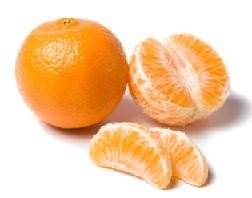
Nutritional Value of Tangerine and Tangerine Juice
| Tangerine nutritional value per 100 g (3.5 oz) Scientific Name: Citrus reticulata |
||
|---|---|---|
| Proximates: | ||
| Nutrients | Tangerines, (mandarin oranges), raw Refuse: 26% (Peel and seeds) | Tangerine juice, raw |
| Water | 85.17 g | 88.90 g |
| Energy | 223 kJ (53 kcal) | 180 kJ (43 kcal) |
| Protein | 0.81 g | 0.50 g |
| Carbohydrates | 13.34 g | 10.10 g |
| Total Fat: | 0.31 g | 0.20 g |
| Fiber | 1.8 g | 0.2 g |
| Cholesterol | 0 mg | 0 mg |
| Minerals: | ||
| Calcium, Ca | 37 mg (4 %) | 18 mg (2%) |
| Iron, Fe | 0.15 mg (1 %) | 0.20 mg (1%) |
| Magnesium, Mg | 12 mg (3 %) | 8 mg (2%) |
| Phosphorus, P | 20 mg (2 %) | 14 mg (1%) |
| Potassium, K | 166 mg (4 %) | 178 mg (4%) |
| Sodium, Na | 2 mg (0.08 %) | 1 mg (0%) |
| Zinc, Zn | 0.07 mg (0.5 %) | 0.03 mg (0%) |
| Copper, Cu | 0.042 mg (2 %) | 0.025 mg (1%) |
| Manganese, Mn | 0.039 mg (2 %) | 0.037 mg (2%) |
| Selenium, Se | 0.1 mcg (0.1 %) | 0.1 mcg (0.1%) |
| Vitamins: | ||
| Vitamin C | 26.7 mg (45 %) | 31 mg (52%) |
| Thiamine (Vit. B1) | 0.058 mg (4 %) | 0.060 mg (4%) |
| Riboflavin (Vit. B2) | 0.036 mg (2 %) | 0.020 mg (1%) |
| Niacin (Vit. B3) | 0.376 mg (2 %) | 0.100 mg (0.5%) |
| Pantothenic acid (B5) | 0.216 mg (2 %) | 0.125 mg (1%) |
| Vitamin B6 | 0.078 mg (4 %) | 0.042 mg (2%) |
| Folate (Vit. B9) | 16 mcg (4 %) | 5 mcg (1%) |
| Vitamin A | 681 IU (14 %) | 253 IU (5%) |
| Vitamin E | 0.20 mg (1 %) | 0 mcg |
| Percentages are relative to US Recommended Daily Intake (RDI) for adults. | ||
Author: Lana Soko
You Might Also Like:

Like This Page?
|
Share This Page:
|

Search Our Site:

Free E-Book:

|
Join the newsletter and get a free welcome pack! |
We Recommend:
Looking to get your body into great shape? Get the very best results for your efforts and money! Save your valuable time from surfing the internet. These are theBestselling Weight Loss Programs
Programs that work and have thousands of satisfied customers worldwide!
 |
HOME Privacy Policy Disclaimer Contact Us
Copyright © 2025 Lose-Weight-With-Us.com. All rights reserved.
